[Easy English Blog] Bottle Sock

bottle2

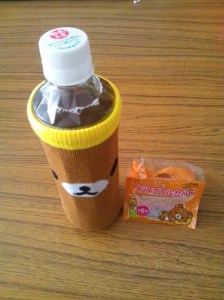
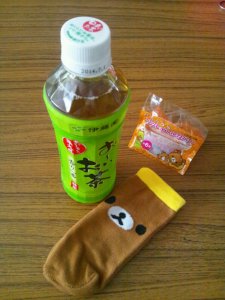
I like green tea very much, so I often buy plastic bottles of it. Sometimes, the bottles I buy come with a free gift.

Usually, the free gifts are key rings, or other small things made of plastic. The other day, I was surprised to see that the gift wasn’t made of plastic. It was like cloth. I opened it, and was even more surprised to see that it was a sock!

My first thought was, “Why have they given me a sock? Why only one?”

Then I realised. It was a sock for the bottle!

bottle1

The tea is stored in the fridge in the convenience store, so when it starts to warm up at room temperature, it gets wet. The sock keeps your hands dry while you drink it.

I don’t know if I’ll get into the habit of using the sock bottle regularly (probably not), but it’s a nice idea. 🙂


[Easy English Blog] Pumpkin and Feta Salad

Cooking and Recipes in English

Pumpkin Salad

Pumpkin and Feta Salad
Since it’s Halloween, I’ve been thinking about pumpkin. Pumpkin is very good for you so finding ways to feed pumpkin to your family is a good idea. Not just at Halloween but all year round.
Everyone in my house likes pumpkin, and this salad is a family favourite.
It’s very quick and easy if you have left over roast pumpkin. However, it tastes so good, that’s its worth cooking pumpkin just for this salad.

If you have to cook the pumpkin, cut it into wedges. Leave the skin on but take the seeds out. Rub the pumpkin with a little olive oil and sprinkle it with salt and pepper. Heat the oven to 180C and cook the pumpkin until the orange flesh is soft. You’ll find it’s easy to take the skin off after it’s cooked.

Salad recipe

  • Two cups of cooked pumpkin cut into 1cm cubes.
  • Half a cup of cubed feta cheese.
  • Half a cup of nuts or seeds (almonds, pinenuts, toasted pumpkin seeds or sesame seeds).
  • Toss the salad together gently with a dressing made from one tablespoon olive oil, salt and pepper to taste and a small amount of oregano.

Thoughts and notes
This salad is best with pine nuts but I often don’t have any. They are expensive and they are not available in all supermarkets. So I sometimes make it with almonds.
If your family doesn’t like feta cheese, try the salad with cubes of cheddar cheese or cream cheese.
Almonds go very well with cheddar cheese and sesame seeds are very successful with cream cheese.
If you buy your feta cheese marinated in olive oil, don’t worry about the salad dressing. Just take a spoonful of the oil out of the jar and use that!

Happy eating!

halloween-decoration-11300115203X1E

[Easy English Blog] Computer Glasses

girl-ontouch-screen-phone


Do you spend a lot of time looking at your computer, tablet, or mobile phone?

I do. Some days I spend over 12 hours looking at my computer screen. This is not good for my eyes.

Of course, I try to protect my eyes by turning the brightness down to “low”. I also take regular breaks. When I take a break, I look out of the window at something far away.

However, recently, my eyes have been feeling tired. I thought, “Maybe I need to do more…”

So, I bought some computer glasses. They have black frames and brown-tinted plastic lenses.

DSC05591


The package says that the glasses cut the amount of blue light reaching your eyes by 50%.

DSC05592

I never really thought about blue light before. We often hear about UV light, and how important it is to wear sunglasses on sunny days. But we don’t hear much about blue light.  It seems that many fluorescent lights (often used in offices and shops) and TV screens also emit blue light.

light-bulb-2

So, I’ve started to wear the computer glasses when I watch TV, or when I’m in a room with bright lights.

I’ve only been wearing them for a week, so I haven’t noticed any changes yet. My eyes still feel tired, but I feel better knowing that the light reaching the back of my eyes is being filtered/reduced.

Nowadays, so many people spend a lot of time looking at screens. I think we have to be careful, and do what we can to protect our eyes. They are very important!

[Easy English Blog] Kaki Season

It is the kaki season!

DSC05585


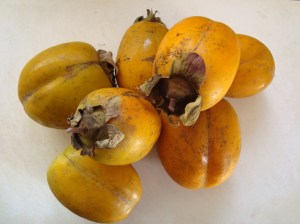
“Kaki” is Japanese for “persimmon”.

Every autumn, the persimmon trees in gardens and along roadsides grow heavy with bright orange fruit.

It is a sign that autumn has come!

Here is a tree with lots of persimmons waiting to be picked and eaten!

DSC05586


The other day, my neighbour gave me a big bag of persimmons. He has a large persimmon tree and he picked some for me.  I was very pleased to receive them.

When he gave me the persimmons, I said, “Oh thank you! I love persimmons!”

He said, “Good! I’ll bring some more next week. Our tree has lots of persimmons this year. We can’t eat them all!”

Here are some of the persimmons he gave me.

DSC05588


I started eating them straight away. (straight away = immediately) The persimmon has a nice shape inside. It’s a bit like a flower I think.

DSC05589


I sliced it up and ate it with yoghurt.  Very healthy (lots of vitamin A and vitamin C!) and very tasty!

DSC05590


[Easy English Blog] Japanese Cooking in English

Cookpad

Some of my students say, “I don’t have time to study English every day. I have to cook in the morning, afternoon and evening. It takes a long time.”

Now, they can study and cook at the same time!

There is a recipe site in Japan. It is called Cookpad.

It is Japan’s most popular and famous recipe site. Users of the site post recipes on their own recipe page. There are over 1.5 million recipes on the site!

Recently, Cookpad started an English version of the website. They are translating thousands of recipes from Japanese to English.

The site is great for people all over the world to learn about Japanese cooking and about Japanese culture. We think it is also good for people who want to study English! The English recipes are very easy to understand.


How you can use the site to study English (Our ideas):

1.  Print out the recipes and make some of the tasty dishes. (This kills 2 birds with 1 stone* – you can cook and study at the same time. No excuses!) 😉

2. Learn cooking vocabulary and phrases.

3. Teach your non-Japanese friends how to cook Japanese dishes.

4. Using the cooking vocabulary you learnt, write your own recipes in English and give them to your friends or teacher.

5. Ask your English teacher if you can have English class in the kitchen one day! Many community centres have kitchens you can rent for a few hours. You can make some of the recipes with your classmates!

Why not make* some tasty dishes in English this weekend? 🙂

The site is here: http://en.cookpad.com/

——————————–

*Kill two birds with one stone = solve 2 problems at the same time.

(So, you have to cook = problem 1. You have to study English = problem 2. Do them at the same time! Problem solved!)

(In Japanese: 一石二鳥 )

*Why not….? = How about…..? This is a suggestion.

(So, Why not make some tasty dishes? = How about making some tasty dishes?)
[Easy English Blog] Rice Harvest in Early Autumn

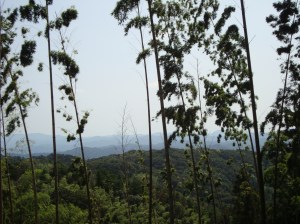
Autumn is my favourite season.  After the long, hot and humid summer, the air starts to get cooler and the leaves on the trees start  to change colour. The sky is clear and we have nice sunny days to enjoy before winter comes. It is a beautiful time of year.

DSC05513

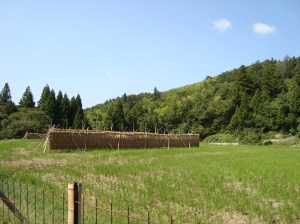
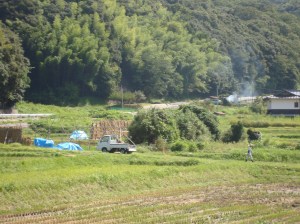
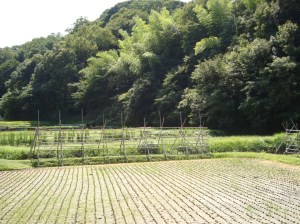
Rural Japan in autumn is beautiful. The rice harvest starts, and all around the countryside you can see freshly harvested rice drying on bamboo racks.

DSC05514

After the harvest, the smell of burning straw lingers on (linger on = stay) around the villages and hills. For me, it is “the smell of autumn”.

It was nice the other day, so I drove out to the countryside. I took some photos of the rice, drying in the sun. For a short while, I watched a farmer working in his rice paddy (rice field). It looked like very hard work. He was an old man. I wondered how long his family had been growing rice on that land. Maybe for hundreds of years?

DSC05483

I think rice farming is a very tough job. Going to the countryside at harvest time reminds us that when we eat rice, we should be thankful.

DSC05529

DSC05526

DSC05528

DSC05516

This is where the rice often ends up! 🙂 (Itadakimasu!)

SANYO DIGITAL CAMERA

Curry and Rice picture by jetalone (Flickr) [CC-BY-2.0 (http://creativecommons.org/licenses/by/2.0)%5D, via Wikimedia Commons

[Easy English Blog] Simple and Convenient

DSC05509

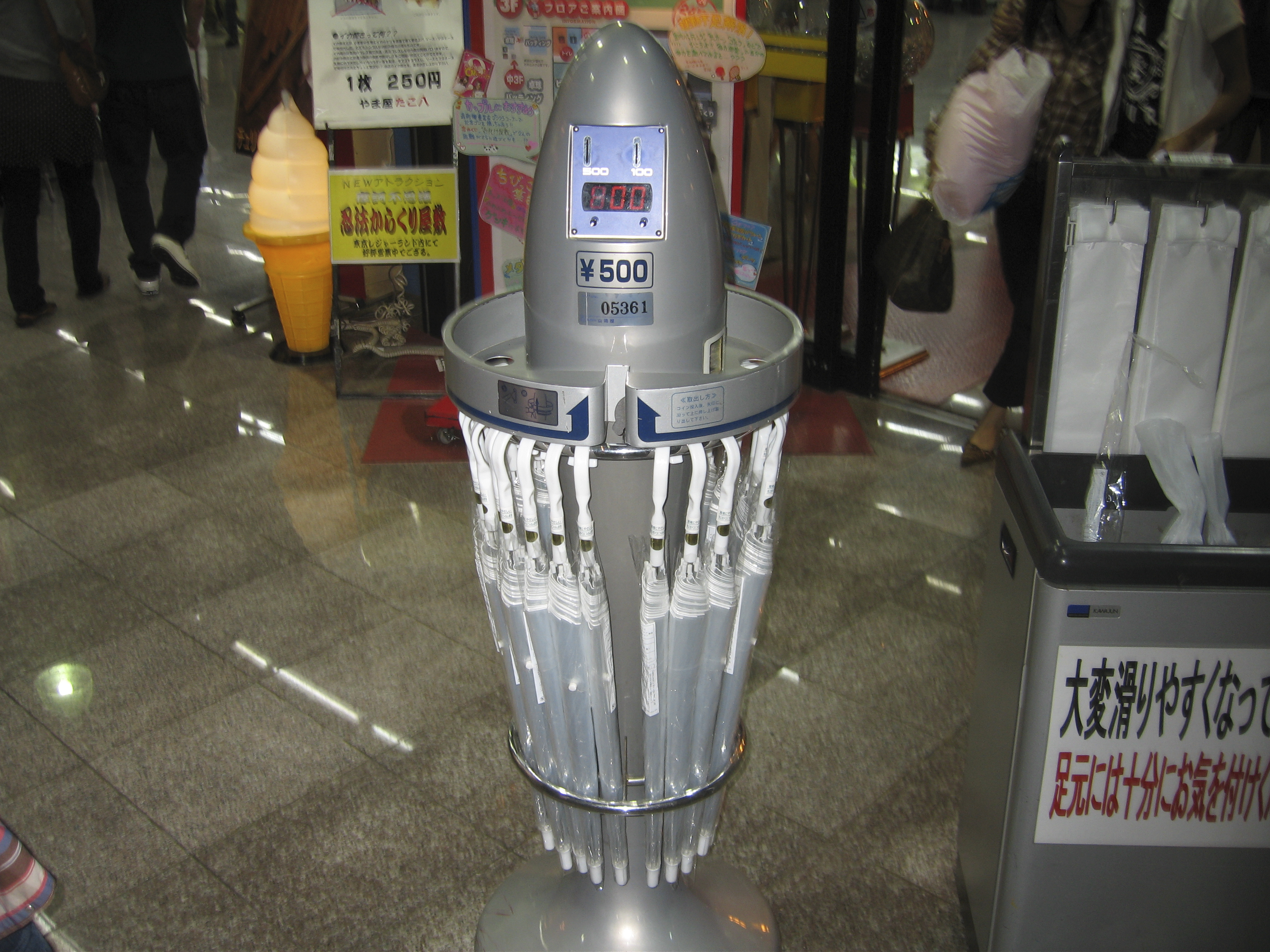
Do you know the English name for the machine in the photo?

It is a “vending machine“.

Here in Japan, vending machines are ubiquitous ( = very common/existing everywhere).

It is said that Japan has more vending machines than any other country.

They are called jido hanbaiki.  自動(jido = automatic) 販売 (hanbai = vending) 機 (ki =machine).


Today, I went for a drive. I went up into the mountains. At the top of the mountain, there were no cars and no people.

But…that’s right….there was a vending machine! I was very glad to see the machine because I needed a drink! 🙂


450px-Japan_cigarette_vending_machine


(By Terence Ong (Own work) [GFDL (http://www.gnu.org/copyleft/fdl.html), CC-BY-SA-3.0 (http://creativecommons.org/licenses/by-sa/3.0/) or CC-BY-2.5 (http://creativecommons.org/licenses/by/2.5)%5D, via Wikimedia Commons)

Many years ago, we could buy beer and cigarettes from vending machines very easily.

A few years ago, a new system was introduced to stop young children and teenagers buying beer and cigarettes.

Now, if you want to use these machines, you need an ID card to prove your age.

450px-Beer_vending_machine_in_Hokkaido,_Japan

(By Mr Wabu (http://flickr.com/photos/oxborrow/81522125/) [CC-BY-SA-2.0 (http://creativecommons.org/licenses/by-sa/2.0)%5D, via Wikimedia Commons)

Some people don’t like vending machines.

They say that they don’t look nice in the countryside. Other people say they use too much electricity.

I like them. I think they are simple and convenient. If you are out and very far from any shops, no problem! There is probably a vending machine on the next corner! 🙂

Forgot your umbrella and it has started to rain? No problem! There’s a vending machine for you too!

800px-Umbrella_vending

(By Jason Ruck (Transferred by Cloudbound/Originally uploaded by Jason7825) (I took it. (Originally uploaded on en.wikipedia)) [GFDL (http://www.gnu.org/copyleft/fdl.html), CC-BY-SA-3.0 (http://creativecommons.org/licenses/by-sa/3.0/) or CC-BY-SA-2.5-2.0-1.0 (http://creativecommons.org/licenses/by-sa/2.5-2.0-1.0)%5D, via Wikimedia Commons)


[Easy English Blog] Do you know this animal?

Tanuki_0161

Do you know the animal in the photograph?

It is a “tanuki”.

“Tanuki” is a Japanese word. It means “racoon dog”.

In rural Japan, tanuki are quite common. We can sometimes see them in the garden at night.  They move very quickly!

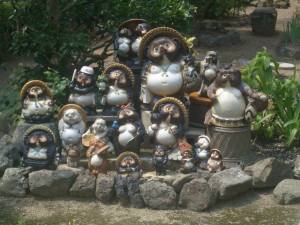
The statues in the photo below are also “tanuki’. These statues are very common in Japan!

Tanuki


Many houses, shops  and restaurants have these statues in front of their house.

In Japanese folklore, it is said that “tanuki” have magic powers.  They have a happy, mischievous image and many people think they bring good fortune.

Would you like to find out more about Japanese “tanuki”? Take a look here!

[Easy English Blog] Summer fireworks

We went to a summer firework display last week.

DSC05436

In Japan, many cities have firework displays in summer. When I first came to Japan, I was very surprised to see fireworks in summer. When I lived in England, I only saw fireworks in winter, on 5th November. (Why 5th November? See here!)

I think summer firework displays are a  great idea. All the local people gather outside in the warm summer evening and enjoy eating and drinking while watching the fireworks.

DSC05439

We had a lot of rain just before the fireworks display, so some people were worried. They thought the display might be cancelled. Luckily, it stopped raining a few hours before the display started.

DSC05431

It was an impressive display. It seems to get bigger and better every year. We are already looking forward to the next one! 🙂

DSC05427

[Easy English Blog] Sand Museum

When I was a child, in the summer time, I used to go to the beach. I enjoyed digging in the sand, and building sandcastles. The castles were only small, but because I was a young child, they seemed really big to me.

I was reminded of long summers on the beach playing in the sand when my friend showed me some photographs from his trip to a sand museum.

A few weeks ago, my friend went to the sand museum in Tottori. It is the only sand museum in Japan. He sent me some pictures, which I would like to share with you on this blog.

When my friend showed me the pictures, I said, “These sand sculptures look amazing”. He said, “They are even more impressive when you see them in real life! If you get the chance, you really should go and see them!”

Here are some of the photographs. I hope you enjoy them!

sandmuseum6

This sculpture is huge! It must have taken a long time to make!

sandmuseum3

The detail on this sculpture is stunning.

sandmuseum2

sandmuseum4

This photo is my favourite. The colours and design are beautiful.

sandmuseum1

I think this one is still being made. I’d like to watch the artist finish it! I hope I can go to Tottori to see the sand sculptures someday!