[Easy English Blog] Computer Glasses

girl-ontouch-screen-phone


Do you spend a lot of time looking at your computer, tablet, or mobile phone?

I do. Some days I spend over 12 hours looking at my computer screen. This is not good for my eyes.

Of course, I try to protect my eyes by turning the brightness down to “low”. I also take regular breaks. When I take a break, I look out of the window at something far away.

However, recently, my eyes have been feeling tired. I thought, “Maybe I need to do more…”

So, I bought some computer glasses. They have black frames and brown-tinted plastic lenses.

DSC05591


The package says that the glasses cut the amount of blue light reaching your eyes by 50%.

DSC05592

I never really thought about blue light before. We often hear about UV light, and how important it is to wear sunglasses on sunny days. But we don’t hear much about blue light.  It seems that many fluorescent lights (often used in offices and shops) and TV screens also emit blue light.

light-bulb-2

So, I’ve started to wear the computer glasses when I watch TV, or when I’m in a room with bright lights.

I’ve only been wearing them for a week, so I haven’t noticed any changes yet. My eyes still feel tired, but I feel better knowing that the light reaching the back of my eyes is being filtered/reduced.

Nowadays, so many people spend a lot of time looking at screens. I think we have to be careful, and do what we can to protect our eyes. They are very important!

[Easy English Blog] Kaki Season

It is the kaki season!

DSC05585


“Kaki” is Japanese for “persimmon”.

Every autumn, the persimmon trees in gardens and along roadsides grow heavy with bright orange fruit.

It is a sign that autumn has come!

Here is a tree with lots of persimmons waiting to be picked and eaten!

DSC05586


The other day, my neighbour gave me a big bag of persimmons. He has a large persimmon tree and he picked some for me.  I was very pleased to receive them.

When he gave me the persimmons, I said, “Oh thank you! I love persimmons!”

He said, “Good! I’ll bring some more next week. Our tree has lots of persimmons this year. We can’t eat them all!”

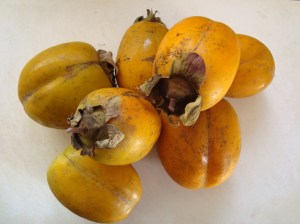
Here are some of the persimmons he gave me.

DSC05588


I started eating them straight away. (straight away = immediately) The persimmon has a nice shape inside. It’s a bit like a flower I think.

DSC05589


I sliced it up and ate it with yoghurt.  Very healthy (lots of vitamin A and vitamin C!) and very tasty!

DSC05590


Dear Ellen Activities

In this category, there are two quizzes for the I Talk You Talk Press graded reader Dear Ellen.

dearellen_cover

1. True/False Quiz

2. Comprehension Quiz

To start the quizzes, click on the green buttons on the quiz pages. Good luck!

—————–

We hope you enjoyed reading Dear Ellen.

Cool as a…

Can you complete this English expression? (Hint: It means “to be very calm”.)

Cool as a….

a) watermelon

b) cucumber

c) fridge


The answer is below! ↓

beach-wallpaper


Answer:

b) Cool as a cucumber!


Example:

A: How was Dave’s speech?

B: It was really good.

A: Was he nervous?

B: He didn’t look nervous. He was as cool as a cucumber.

[Easy English Blog] Japanese Cooking in English

Cookpad

Some of my students say, “I don’t have time to study English every day. I have to cook in the morning, afternoon and evening. It takes a long time.”

Now, they can study and cook at the same time!

There is a recipe site in Japan. It is called Cookpad.

It is Japan’s most popular and famous recipe site. Users of the site post recipes on their own recipe page. There are over 1.5 million recipes on the site!

Recently, Cookpad started an English version of the website. They are translating thousands of recipes from Japanese to English.

The site is great for people all over the world to learn about Japanese cooking and about Japanese culture. We think it is also good for people who want to study English! The English recipes are very easy to understand.


How you can use the site to study English (Our ideas):

1.  Print out the recipes and make some of the tasty dishes. (This kills 2 birds with 1 stone* – you can cook and study at the same time. No excuses!) 😉

2. Learn cooking vocabulary and phrases.

3. Teach your non-Japanese friends how to cook Japanese dishes.

4. Using the cooking vocabulary you learnt, write your own recipes in English and give them to your friends or teacher.

5. Ask your English teacher if you can have English class in the kitchen one day! Many community centres have kitchens you can rent for a few hours. You can make some of the recipes with your classmates!

Why not make* some tasty dishes in English this weekend? 🙂

The site is here: http://en.cookpad.com/

——————————–

*Kill two birds with one stone = solve 2 problems at the same time.

(So, you have to cook = problem 1. You have to study English = problem 2. Do them at the same time! Problem solved!)

(In Japanese: 一石二鳥 )

*Why not….? = How about…..? This is a suggestion.

(So, Why not make some tasty dishes? = How about making some tasty dishes?)

[Easy English Blog] Rice Harvest in Early Autumn

Autumn is my favourite season.  After the long, hot and humid summer, the air starts to get cooler and the leaves on the trees start  to change colour. The sky is clear and we have nice sunny days to enjoy before winter comes. It is a beautiful time of year.

DSC05513

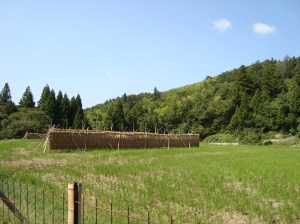
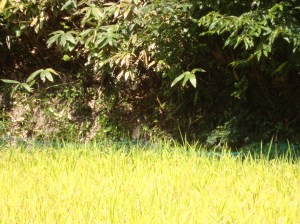
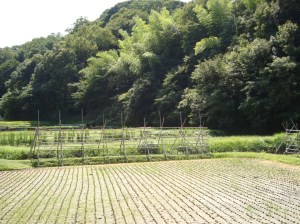
Rural Japan in autumn is beautiful. The rice harvest starts, and all around the countryside you can see freshly harvested rice drying on bamboo racks.

DSC05514

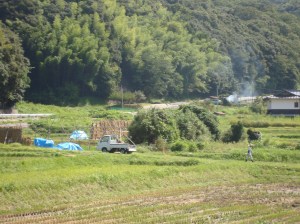
After the harvest, the smell of burning straw lingers on (linger on = stay) around the villages and hills. For me, it is “the smell of autumn”.

It was nice the other day, so I drove out to the countryside. I took some photos of the rice, drying in the sun. For a short while, I watched a farmer working in his rice paddy (rice field). It looked like very hard work. He was an old man. I wondered how long his family had been growing rice on that land. Maybe for hundreds of years?

DSC05483

I think rice farming is a very tough job. Going to the countryside at harvest time reminds us that when we eat rice, we should be thankful.

DSC05529

DSC05526

DSC05528

DSC05516

This is where the rice often ends up! 🙂 (Itadakimasu!)

SANYO DIGITAL CAMERA

Curry and Rice picture by jetalone (Flickr) [CC-BY-2.0 (http://creativecommons.org/licenses/by/2.0)%5D, via Wikimedia Commons