Old Jack’s Ghost Stories from England (2)

This page has information about the places in Old Jack’s Ghost Stories from England (2).
oldjackengland2_cover


1. Chester City Walls

Chester is a very old, historic city in North West England. It was built by the Romans around 2000 years ago. The Romans built walls around the city to protect it. The walls are still there today. They are around 2 miles (3.2km) long. The walls are a tourist attraction, and many people enjoy walking along the walls. If the weather is nice, walking along the walls is a great way to see Chester!


450px-St_Martin's_Gate,_Chester

Photo: By orangeacid (Flickr) [CC-BY-2.0 (http://creativecommons.org/licenses/by/2.0)%5D, via Wikimedia Commons

Other interesting places in Chester:

Chester Amphitheatre. It is said that the Romans used this amphitheatre for sports such as boxing and wrestling, and gladiator fighting!

Roman_amphitheatre,_Chester_(14)

Photo: By Rept0n1x (Own work) [CC-BY-SA-3.0 (http://creativecommons.org/licenses/by-sa/3.0)%5D, via Wikimedia Commons

Map: 


2. The Feathers Hotel, Ludlow, Shropshire

The Feathers Hotel was built in the 17th Century. It is very famous for its beautiful architecture and design. It is in the centre of Ludlow, a very old market town in Shropshire. Ludlow has many historic buildings and is in the middle of beautiful countryside. It is not far from the border between England and Wales.

800px-The_Feathers_Hotel,_Ludlow_-_IMG_0163

Photo: By Green Lane (Own work) [GFDL (http://www.gnu.org/copyleft/fdl.html) or CC-BY-SA-3.0-2.5-2.0-1.0 (http://creativecommons.org/licenses/by-sa/3.0)%5D, via Wikimedia Commons


Map:

Other interesting places in Ludlow:

Ludlow Castle: Ludlow Castle was built in the 11th Century. You can walk around the castle and learn about its history.
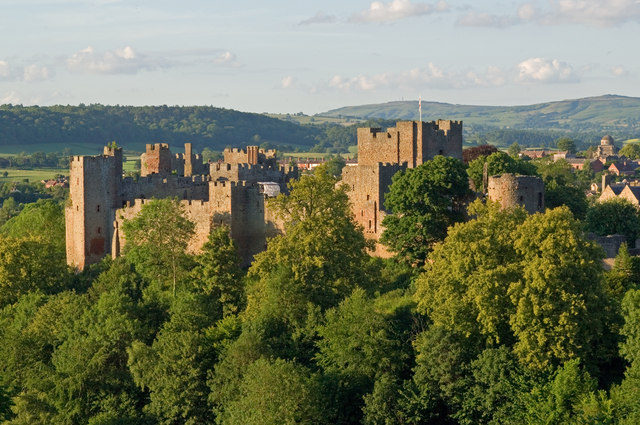
Ludlow_Castle_from_Whitcliffe,_2011

Photo: Ian Capper [CC-BY-SA-2.0 (http://creativecommons.org/licenses/by-sa/2.0)%5D, via Wikimedia Commons


3. Ye Olde Starre Inne, York

Ye Olde Starre Inne  is York’s oldest pub. It has been a pub since 1644. It is very near to York Minster. It is in a street called Stonegate. This street is very famous because Guy Fawkes, one of England’s most famous people, was born here in 1570.

Ye_Olde_Starre_Inne,_1644AD_-_geograph.org.uk_-_407900

Map:


4. Hampton Court Palace, London

Hampton Court Palace is one of London’s most famous palaces. It used to be owned by Henry VIII. It was built around 1514. Now, it is a very popular tourist attraction. The palace has many antiques and works of art. It also has gardens and a maze, called Hampton Court Maze.

It is open every day from 10:00am – 6:00pm.

800px-Hampton_Court_Palace_20120224

Photo: By James Park-Watt (Own work) [CC-BY-SA-3.0 (http://creativecommons.org/licenses/by-sa/3.0)%5D, via Wikimedia Commons

Hampton Court Maze
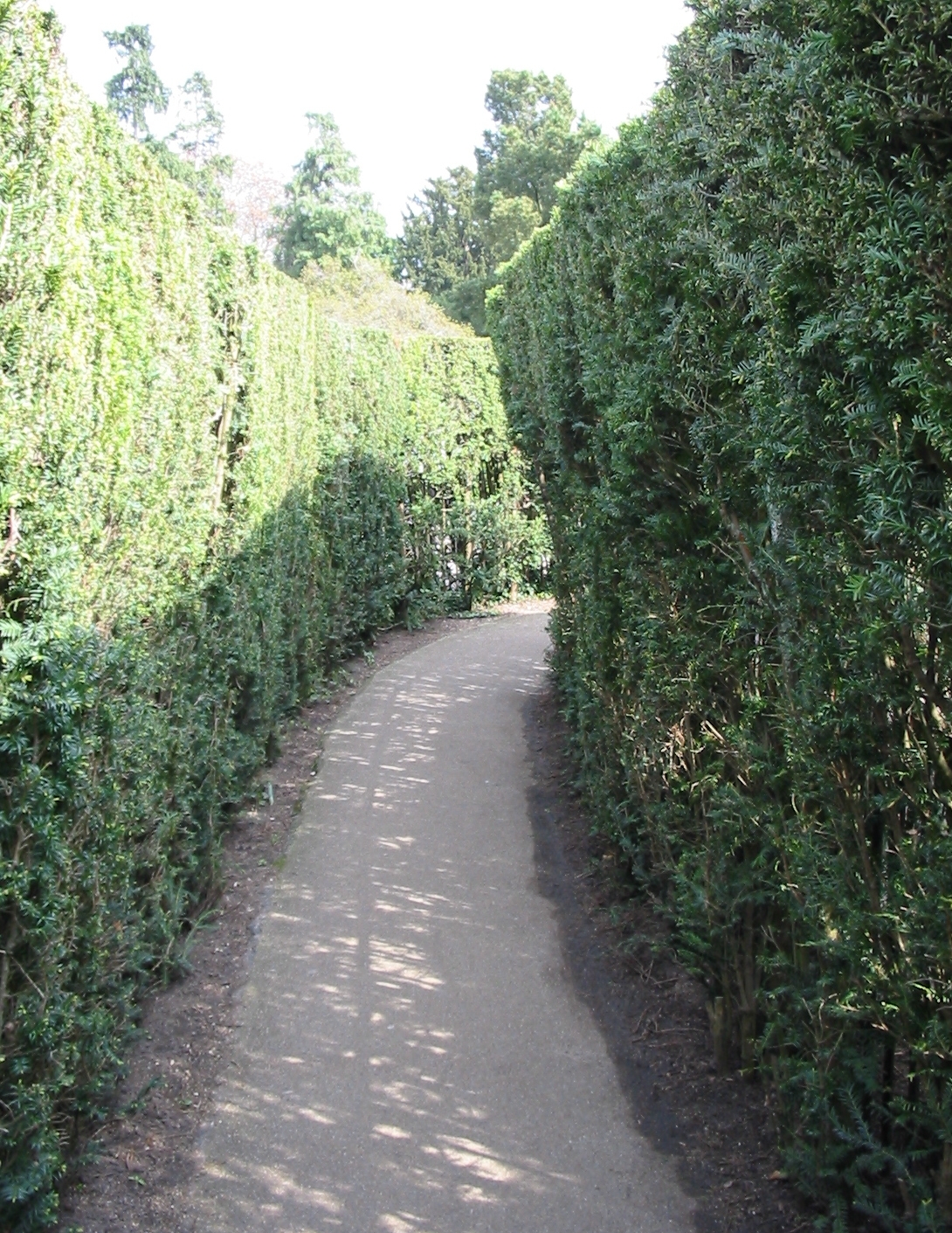
463px-Hampton_Court_Avri_2009_42

Photo: By Man vyi (Own work (own photo)) [Public domain], via Wikimedia Commons


Map: 


5. Tower of London, London

The Tower of London is another very famous tourist attraction in London. It was built in the 11th Century by William the Conqueror. It is famous for being a prison, where many people, including kings, queens and princes, were kept and killed.

It is open every day, from 9:00am-5:30pm Tuesday to Saturday, and 10:00am to 5:30pm on Sunday/Monday.

417px-London_-_White_Tower

Photo: By Crux [CC-BY-SA-2.5 (http://creativecommons.org/licenses/by-sa/2.5)%5D, via Wikimedia Commons


Map: 


6. Dover Castle

Dover Castle is England’s largest castle. It was built in the 12th Century. It is a popular tourist attraction and has a great tower, secret tunnels and views of the sea.
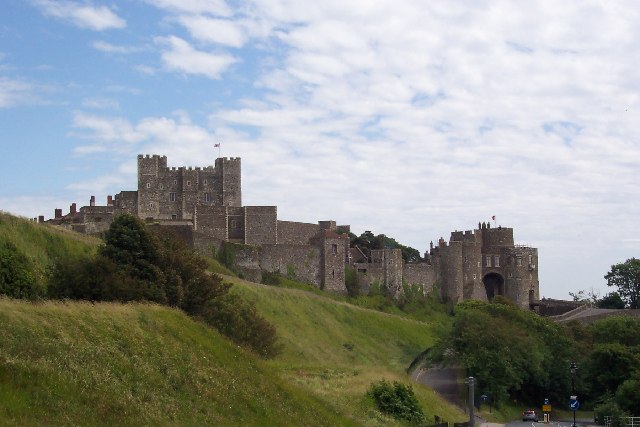
Dover_Castle_-_geograph.org.uk_-_41764

Photo: Ron Strutt [CC-BY-SA-2.0 (http://creativecommons.org/licenses/by-sa/2.0)%5D, via Wikimedia Commons

Website: http://www.english-heritage.org.uk/daysout/properties/dover-castle/

Map: 

to have a ball

Do you know the English phrase “to have a ball”? 

Can you guess what it means?

Example:

A: How was the party last weekend.

B: It was great! We had a ball!


Does it mean

a) to have a really good time

b) to attend a ball

c) to receive a ball

d) to play a ball game

The answer is below! ↓


woman-with-beach-ball


Answer: a) to have a really good time

I went out with my friends in Tokyo a few weeks ago. We went to a restaurant, and then we went to a few bars. We had a ball!

How about you? When was the last time you had a ball?

[Easy English Blog] A Mere Trifle

Cooking and recipes in English.

A friend bought me a packet of port wine jelly from Australia. In America, jelly is called jello.

I was wondering what to do with it. “It’s very popular in Australia,” my friend said. “People make trifle with it.”

“Ah,” I thought. “Trifle! I haven’t made trifle for years.”

This is what I did to make a trifle.

I made the jelly and put it in the refrigerator to set.

I made a pint (450ml) of custard. I was in a hurry so I used a packet of instant custard. Be careful though. You want the custard to be thick. So use only half the amount of milk that the instructions say.

I bought a sponge cake from the supermarket. I broke it up into pieces. I divided the pieces into three piles. I used one pile to make a layer of sponge cake in a glass bowl and poured some apple juice over it.

I chopped up the jelly and put half of it over the sponge cake.

I poured half the custard over that.

Then I repeated the layers; sponge cake with apple juice, jelly, custard.

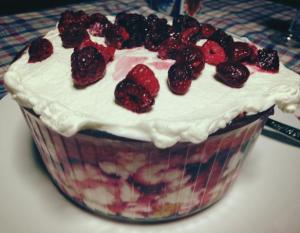
I put the last pile of pieces of sponge cake on top. I put it in the refrigerator and forgot about until it was time for dessert. Then I decorated the top with cream and raspberries. Here is a picture. It’s not very pretty is it?

trifle

Trifle is a traditional English dessert. It usually has custard, sponge cake and fruit. Every family has their own recipe. Everyone has a strong opinion about the recipe and they are all different.

Some people soak the sponge cake in sherry. Other people use fruit juice. Many people use jelly in a trifle. My mother never did. She always spread the sponge cake with strawberry jam. The friend who gave me the jelly said, ”Where are the peaches? I always put canned peaches in trifle!”

So maybe a trifle is whatever you want it to be.

Have you ever made a trifle?

*Note: trifle is an interesting word. Look it up! It means something small and unimportant;  “a mere trifle”.

If you ever heard two cooks discussing dessert trifle, you might get another idea! Something large and rather important! This is because everyone has their own ideas about how to make a trifle. Modern trifles often have many ingredients so there are many things for cooks to disagree about.

The original trifles in the 17th century were probably rather simple desserts. Just fruit and custard or fruit and cream. They were also sometimes called fools.

This simple version “a trifle” is still popular in modern English cooking and it is called a fool. But  the modern trifle always has cake in it.

(P)

There’s no place…

Can you complete this English saying?

There’s no place…

a) like the office

b) like one’s country

c) like home

d) like this place

The answer is below! ↓

house


Answer: c)

There’s no place like home.

Meaning: Home is the best place.


Example:

A: Are you going anywhere in the summer holidays?

B:  No I’m staying here. There’s no place like home!


What do you think? Do you agree with the phrase “There’s no place like home”? 🙂


A Surprise Birthday Party – Lesson Plan

A free, printable lesson plan based on our Fast 500 Easy English story A Surprise Birthday Party

1-1265898884okHs

Download file (PDF) No Sweat! – A Surprise Birthday Party

We hope you and your students enjoy this lesson and we welcome any feedback!

(Update: 9th September, 2013 – Typo in the story corrected and file re-uploaded.)

Our teaching resource section is a work in progress, and your thoughts and insights will help us to improve and expand this series of short fiction and lesson plans.

[Easy English Blog] Snow peas

Cooking and recipes in English.

snowpeas


A friend gave me a bag of snow peas. He had just picked them from his garden. So I made stir fried beef with snow peas.

I had some beef in the freezer so I defrosted it. I try to catch it before it is completely defrosted. It is easier to cut thin slices if the meat is still half-frozen.

Most recipes don’t have cashew nuts. But I added some because my family likes them.

Recipe (for 4)

400g thinly sliced beef

2 tablespoons (30ml) soy sauce

1 tablespoon (15ml) sherry or mirrin

1 tablespoon (15ml) sugar

2 tablespoons (30ml) of grated ginger

2 cloves of garlic chopped

1 teaspoon (5ml) of cornflour)

2 cups snow peas

½ cup cashew nuts (if you like them)

2 tablespoons of cooking oil (I used peanut oil)

chopped red and green peppers


This was very quick – I put the soy sauce, sherry, sugar and cornflour in a bowl and mixed them together well.

Then I added the garlic, ginger and beef, and stirred until the meat was mixed with the seasonings.

Then, I left it all for a few minutes.

I washed the snow peas  and took the leaves off the top. The ones in shops usually have these removed already.

I heated the oil and threw the contents of the bowl into the wok. When the beef looked almost done I added the snow peas and stirred.

I sprinkled the chopped red and green peppers on top, and the meal was ready.


Thought: My peas were very young. If you buy them in the supermarket, they might be older. So you might have to drop them into boiling water for a minute. Drain the peas and run cold water over them. Then shake them dry before you add them.

My friend also gave me a box of freshly picked strawberries so we had them for dessert. You have to love this time of year!

Stir fries are great when the weather gets hotter. They need almost no cooking so there is not too much heat in the kitchen.


Do you have a favourite stir fry combination?

(P)

to bide (one’s) time

DSC05404

Do you know the phrase “to bide (one’s) time“?

Look at the examples below. Can you guess the meaning?

E.g. 1:

A: Has Mike found a new job yet?

B: No, he isn’t even looking. He’s biding his time until the new factory opens near his house.

E.g. 2:

A: I heard Nelly said some bad things to you  in the meeting yesterday. What did you do?

B: I didn’t do anything.

A: No? Why not?

B: I’m biding my time.  The CEO is coming to our office next month. Maybe that will be a good chance to get revenge. Heheheh…

A: Ooh, nasty!

—–

Could you guess the meaning?

to bide (one’s) time = to wait patiently for a good chance.